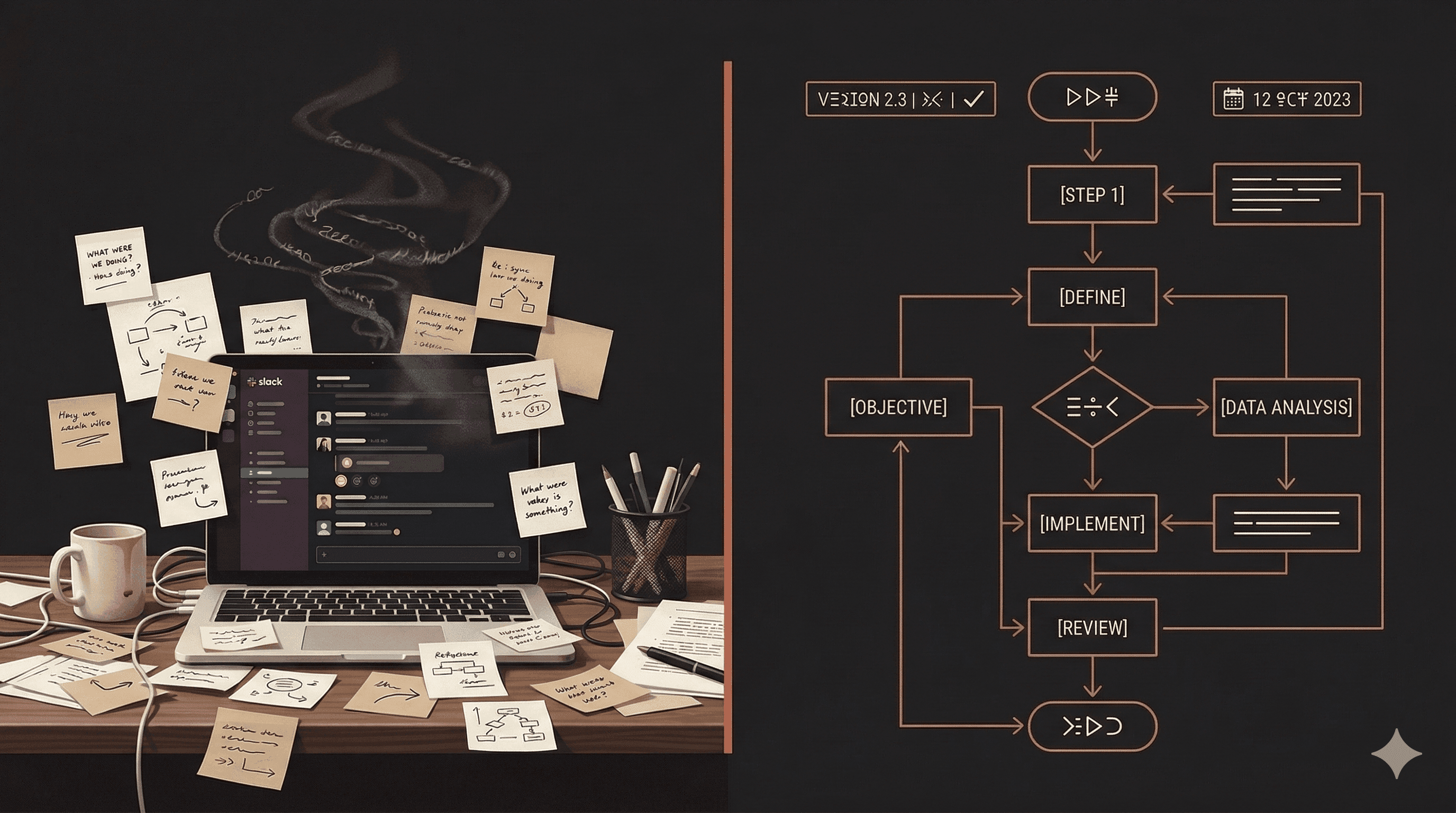
The Intelligence Architect is the person who codifies domain expertise into structured skills that AI agents follow consistently. Unlike prompt engineers who write one-time instructions, Intelligence Architects build persistent, compounding intelligence layers — turning decades of professional judgment into reusable systems that get better with every correction. This role is emerging as the highest-leverage human position in the AI-driven reorganization of knowledge work.
Table of Contents
- What does an Intelligence Architect actually do?
- Why are organizations restructuring around this role?
- How is the T-shaped professional changing?
- What is the difference between a prompt and a skill?
- What is the one-generation problem in AI?
- How do you become an Intelligence Architect?
- Frequently Asked Questions
What does an Intelligence Architect actually do?
An Intelligence Architect translates proprietary expertise into structured intelligence that AI can follow repeatedly. They define outcomes, encode judgment into reusable skill files, and maintain the intelligence layer that separates useful AI from generic AI. Without an Intelligence Architect, AI agents are expensive interns — smart but directionless.
The role became visible through production work across industries. A senior restructuring partner at a top-tier law firm codified 25 years of covenant analysis expertise into 46 skill files. These files encode how to read 300–800 page credit agreements — determining what new debt a borrower can take on, which assets can move, and what consent is required.
The results: 93% accuracy against expert benchmarks. What previously required 200 associate hours and 2–3 partner hours per deal now takes 2 associate and partner hours combined.
The partner didn't write code. He translated judgment into structured rules, preferences, and heuristics. That translation is the core work of the Intelligence Architect.
Three roles emerge in the new organizational model:
- Intelligence Architect — builds the playbook by codifying proprietary expertise into skills, defining quality standards, and maintaining the intelligence layer
- Full-Stacker — runs the plays by using skills and agents to deliver end-to-end outcomes across functions (Full-Stack Marketer, Full-Stack FP&A, Full-Stack Legal Ops)
- Agent — executes the work by orchestrating based on the intelligence given, scaling without adding headcount
The relationship flows in one direction: Intelligence Architect enables the Full-Stacker, who directs the Agent.
Why are organizations restructuring around this role?
Organizations are restructuring because making individuals faster with AI tools does not make organizations more productive. Foundation Capital's survey of 25 companies in March 2026 found engineering teams shrinking from 120 to 25, expert-to-generalist ratios collapsing from 1:6 toward targets of 1:100, and product-engineering-design functions merging from three roles into two.
This pattern repeats across every major technology transition. Factories that swapped steam engines for electric motors in the 1890s but kept the same floor layout saw no productivity gains for 20 years. Cars entered streets built for pedestrians in the 1900s — the real transformation came when roads, highways, and suburbs were redesigned around the automobile. Organizations using AI to speed up individual tasks without redesigning workflows are repeating the same mistake.
Jack Dorsey restructured Block by cutting 4,000 of 10,000 employees — not as downsizing, but to replace hierarchical information routing with what he calls an "Intelligence Layer" that composes capabilities into solutions for specific customers at specific moments (March 2026). Block's new structure defines three human roles that work at the edge of this intelligence system:
- ICs (Individual Contributors) — build the system itself
- DRIs (Directly Responsible Individuals) — own cross-cutting outcomes for 90-day cycles
- Player-coaches — combine hands-on craft with people development
The pattern across Block, Foundation Capital, and production deployments points in the same direction: humans move to the edges — judgment, trust, ethics, accountability — while an intelligence layer handles coordination and execution.
Foundation Capital identified four human roles that persist as agents take over:
| Role | Function | Leverage |
|---|---|---|
| Chief Accountability Officers | Own outcomes, sign filings, face regulators | Grows with AI scope |
| Systems Architects | Design how humans and agents collaborate | Highest leverage — steepest learning curve |
| Relationship Experts | Build trust, navigate politics, maintain culture | More differentiated as AI handles routine |
| Validators | Review agent output at the boundary of AI capability | Bell-curve demand — surging now, peaks in 2–4 years |
The Systems Architect in Foundation Capital's framework maps directly to the Intelligence Architect: the person who designs the intelligence layer that agents operate within.
How is the T-shaped professional changing?
The T-shaped professional retains the same shape but gains a different multiplier. The vertical bar — deep domain expertise — remains essential. The horizontal bar shifts from collaborating with human specialists to directing AI agents across adjacent functions.
Old T: Deep expertise in one domain + broad awareness of others. The team around you was the multiplier. You collaborated with human specialists to deliver outcomes.
New T: Deep domain knowledge (still yours) + ability to direct AI agents across every adjacent function. Your skills plus agents are the multiplier. You deliver end-to-end outcomes that used to require a team.
Anthropic's Applied AI team confirmed this shift from the hiring side: they value breadth of skill set over depth in one thing. The model handles the depth. The human provides breadth and judgment (April 2026).
This is the Full-Stacker in action — the professional who uses structured skills and agent direction to operate across functions. Full-Stack Marketer. Full-Stack FP&A. Full-Stack Legal Ops. The Intelligence Architect makes this possible by building the skills that Full-Stackers use.
What is the difference between a prompt and a skill?
A prompt is a one-time instruction that starts from scratch every conversation. A skill is persistent, structured intelligence that compounds with every use — remembering rules, learning from corrections, and getting better over time.
| Dimension | Prompt | Skill |
|---|---|---|
| Persistence | Starts from scratch every session | Persists across all sessions |
| Learning | No memory of past corrections | Learns from every correction |
| Consistency | Drifts over time | Compounds over time |
| Structure | Freeform text instruction | Layered intelligence — domain base, personal preferences, situational context |
| Scalability | One person, one conversation | Shareable, reusable, version-controlled |
Skills follow a three-tier architecture:
- Domain Intelligence Layer (bottom) — universal knowledge like spam detection patterns, triage heuristics, and industry best practices. Stable, shareable across practitioners.
- Personal Preferences (middle) — your VIP senders, response style, archive rules, and quality standards. This is your competitive edge.
- Situational Context (top) — active deals, current projects, this week's priorities. Changes frequently.
The bottom layer is shareable on platforms like myAgentSkills.ai. The middle layer is proprietary. Together, they compound — which is why prompts drift while skills compound.
What is the one-generation problem in AI?
The one-generation problem is the risk that if AI agents handle all junior work, the next generation of domain experts will never develop the judgment that makes human oversight valuable. Today's validators are experts because they did the reps — senior engineers wrote junior code first, doctors completed residencies, lawyers reviewed thousands of contracts.
The validator pool is a one-generation asset. Unless organizations deliberately create new pathways for expertise development, the knowledge that makes human oversight meaningful will erode within a decade.
This is the most urgent reason the Intelligence Architect role matters: someone must codify expertise into structured skills before the experts who hold that expertise retire. The 46 skill files from the restructuring partner represent irreplaceable institutional knowledge made permanent and transferable.
Anthropic's Applied AI team reinforced this from a different angle: as models improve, soft skills matter more — understanding what to build, communicating effectively, and knowing how to guide people through using AI. The technical execution gets automated. The judgment, empathy, and communication compound (April 2026).
How do you become an Intelligence Architect?
You become an Intelligence Architect by identifying the workflows where you already apply judgment that you've never written down — and turning them into structured skills.
Start with this exercise:
Think of one workflow you do every week that follows rules you've never documented. Something where you always apply the same judgment but re-explain it every time you ask AI for help.
Three questions to find your first skill candidate:
- What do you triage, prioritize, or sort? — emails, leads, applications, claims, tickets
- What do you review against a checklist only you know? — contracts, proposals, reports, code, creative briefs
- What do you always explain the same way to new hires? — processes, standards, quality checks, escalation rules
That workflow is your first skill candidate. The difference between starting and not starting is the difference between a prompt that drifts and a skill that compounds.
Anthropic's Applied AI team said it directly: do the job before you have the job. You don't need a title to start codifying your expertise. The first step is identifying the skill (April 2026).
Frequently Asked Questions
What is an Intelligence Architect in AI?
An Intelligence Architect is a professional who codifies domain expertise into structured, reusable skills that AI agents follow consistently. They translate years of professional judgment into layered intelligence systems — combining universal domain knowledge, personal preferences, and situational context — that compound with every use and correction.
How is an Intelligence Architect different from a prompt engineer?
Prompt engineers write one-time instructions that start from scratch each session. Intelligence Architects build persistent skill systems with three layers (domain knowledge, personal preferences, situational context) that learn from corrections, maintain consistency, and scale across teams. Prompts drift over time; skills compound.
What is the one-generation problem?
The one-generation problem describes the risk that AI agents handling all entry-level work will prevent the next generation of professionals from developing the judgment that makes human oversight valuable. Today's domain experts built expertise through repetitive junior work — residencies, apprenticeships, years of document review. If AI eliminates those reps, the expertise pipeline breaks within one generation.
What skills does an Intelligence Architect need?
Intelligence Architects need deep domain expertise in their field, the ability to decompose tacit knowledge into explicit rules, strong communication skills for translating judgment into structured formats, and enough AI literacy to understand how agents consume and apply skills. Anthropic's Applied AI team emphasizes breadth over depth and soft skills over technical execution.
What is the difference between a prompt and a skill in AI?
A prompt is a one-time instruction with no memory or learning capability. A skill is a persistent, structured intelligence system that remembers rules, learns from corrections, and improves over time. Skills use a three-tier architecture: domain intelligence (universal), personal preferences (proprietary), and situational context (dynamic).
Key Takeaways
The future of knowledge work centers on three emerging roles: the Intelligence Architect who codifies expertise, the Full-Stacker who directs agents across functions, and the Agent that executes at scale. The Intelligence Architect is the highest-leverage human role because without structured intelligence, AI agents remain expensive interns. The one-generation problem makes this urgent — expertise must be codified before the experts who hold it retire.
Your AI is smart. Make it an expert.
Start building: browse pre-built skills at myAgentSkills.ai or take the Claude Skills Masterclass on Maven.